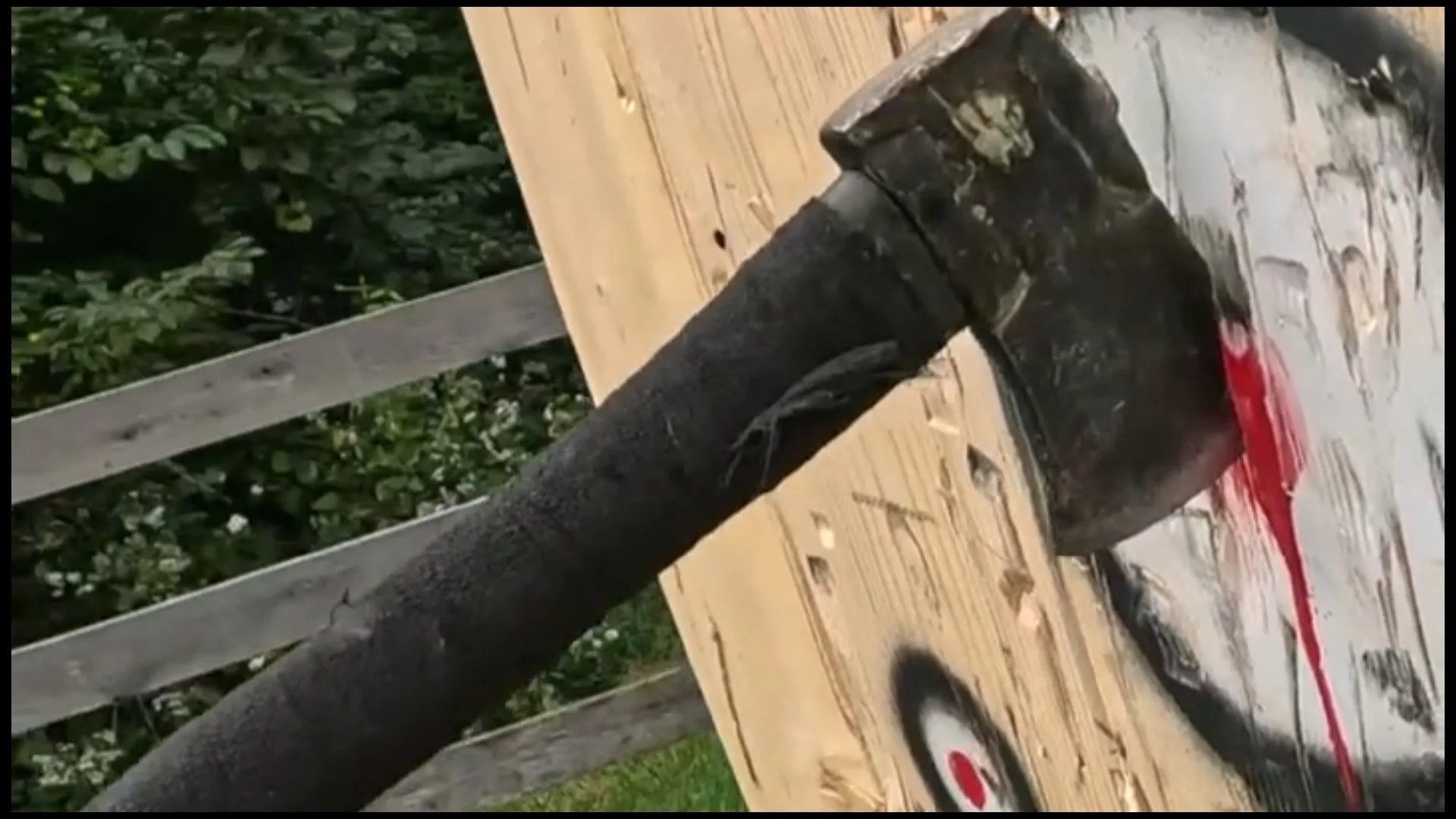
Learning axe-ceptance
After nine years of teaching recurve archery at the Ohio Renaissance Festival, my new boss put me on the knife-throwing wall…on my first day. The next day, I was put on the axe-throwing wall. I had no idea how to throw knives or axes. People came up to me asking how to do something, and I had to tell them I did not know. People just assumed I knew how because I was working there. But I figured it out. Because I had to.
Now, I am ready to teach other people the art of axe throwing. Something I always invalidated since I was doing something (archery) more “complicated”.
They are just throwing things. Anyone can throw something. Not everyone can do archery. Or at least that is what I used to think.
Still the Same Person
I always thought of myself as “the archer”. I wear tights and have arrows sticking out of my hat → so this became part of my identity. When I was told I would not be at archery, I spiralled. I still do when people come up to me and remind me that I am not in the “right” place.
But I am still a teacher. It makes me happy when people look to me for guidance. It makes me feel useful. People throw all five axes the same way, make no adjustments, and are befuddled when none of the axes stick.
But feedback matters. It is how we are supposed to improve. Some people make axcuses:
This is not the right distance. (So scoot back.)
These axes are not meant for throwing. (Because they aren’t tomahawks, they are hatchets with fiberglass handles.)
These axes aren’t sharp enough. (So you do not hurt yourself.)
But I do not want people to walk away dissatisfied. Not by spending (or wasting) their money on something that they thought they would be better at. Disappointed with themselves. “Why am I so bad at this?” Because you have never done it before! Give yourself some grace. Recognize how far you have come. Here is where you can improve.

So let me axe you something:
Have you ever thrown an axe? Do you know how it works? In the following video, Axel Throws demonstrates how an axe should be thrown.
Speed: Throwing too hard makes the axe travel too quickly, meaning it cannot rotate properly. Not throwing hard enough means the blade does not have enough force to stick into the wood. However, it does not matter how hard you throw if it does not rotate properly.
Distance: The farther you are from your target, the axe needs to rotate more. If the handle hits the board, you need to scoot back. If the top of the axe head hits the board, you need to scoot forward.
Rotation: Rotation is determined by distance. For example, from 12-15 feet away, the axe needs to only rotate once. From 24-27 feet, the axe should rotate at least twice. From 36 feet, it rotates about three times.
Blade angle: Your wrist does a lot of the hidden work. If you twist your wrist at the end, the blade can hit the board at the wrong angle, meaning it will not stick.
Just pay attention to what happens. If it sticks, then you did it! If not, there is always some adjustment you can make.
Our Prices
Whether you want lessons or just want to throw solo or with a partner, we can help you find what you are looking for.
Not sure if you really want to throw axes? Come and visit our range, see our axes and targets and decide if you want to continue throwing or not.
One free throw!
Throw as many axes as you want within a half hour or one hour period.
$10 per half hour.
$20 per hour.